
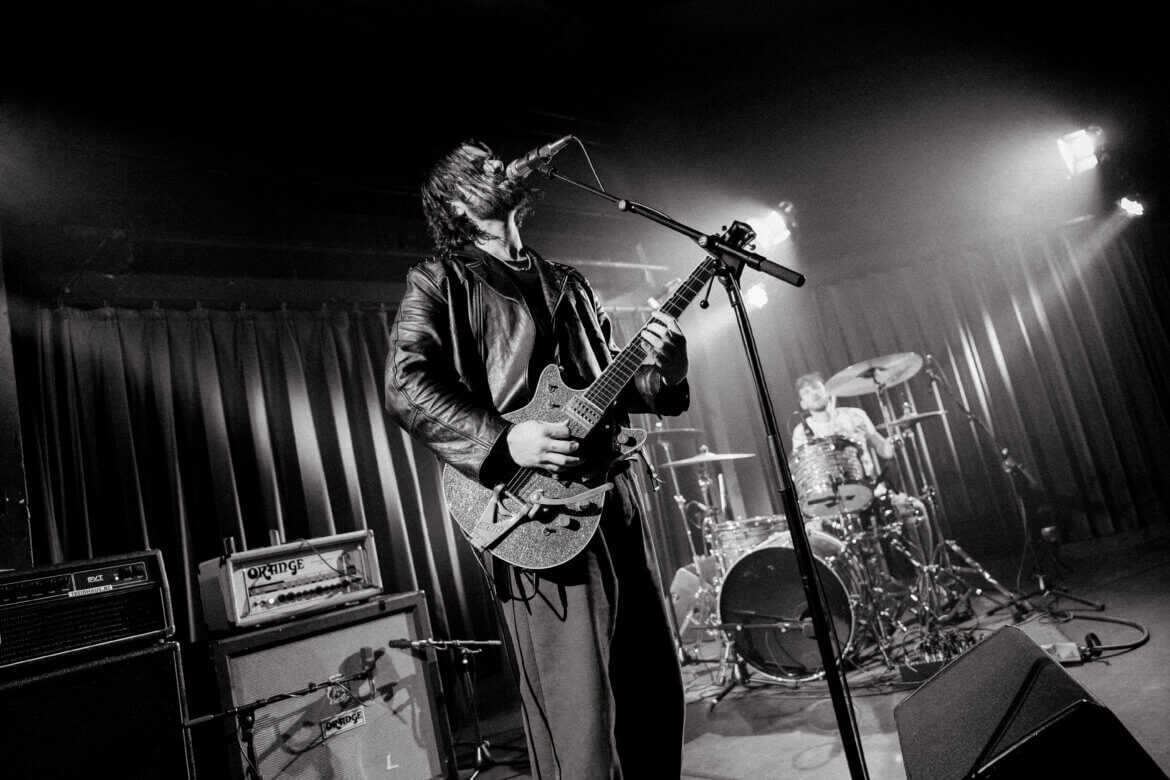
Rett Smith is sitting across from me in a hotel bar in a black leather jacket (what else?), sipping on a gin and tonic. It’s the first really cold day of the waning fall and waxing winter. In about two hours, Smith will take the stage at Treibhaus – he just came from the sound check. He is self-assured, calm and collected, and I can tell that he’s intelligent. I can also tell that he doesn’t take any shit from anyone.
From Texas to Axams and back
What you might not be able to tell about Smith, with his American rockstar aura, is that he was a competitive alpine skier in a previous life – a career path that had him living in Tyrol part-time as a teenager. Originally from Texas, this is his first time being back since he started playing music.
“I spent the majority of my life from 12 to almost 16 at Axamer Lizum and living in Axams, and so I’ve spent a lot of time in Innsbruck. I remember hopping on the bus and coming down on off days as a kid and being in this exact area. It brings back some feelings that I didn’t expect,” he says. “It is funny, the things that your body remembers that your conscious mind doesn’t. Walking around, and the market and the Glühwein, and the smells, and remembering corners and knowing to turn right, and just strange, strange things.”
Does he miss it? “No,” he responds decisively. But he also wouldn’t change anything about his trajectory and how that time in his life shaped him. “I wouldn’t be playing music if I hadn’t lived here.”
Smith wrote, mixed, and produced his new album A Physical Persistence completely on his own. “This was very much a singular effort, in the sense of, ‘Stay out of the way.’ I just wanted it to sound a very specific way. Right now, everything sounds so fucking similar in every genre that I was like, I have to make one that sounds the way I want it to, to the end.” Still, Smith didn’t do everything on his own. “I had it mastered at Abbey Road with Stefan [Brown], who’s a good friend of mine. We collaborated a lot on the final mixes.” While making the record, Smith says he became obsessive and lived like a hermit, completely giving himself to the process. “I wouldn’t recommend it. There’s ways to do the work without being ridiculous.”
Lyrics first
The record is defined by guitar riffs. Over the instruments, it’s sometimes difficult to make out the words. But that doesn’t mean that lyrics are secondary to Smith – in his process, they actually come first. “I write lyrics more like prose on the page. Once you already have a great lyric or at least a decent lyric or my lyric or whatever, you can actually fit that into a melody pretty easy. It keeps you from writing stupid songs because, unless you’re the Beatles, you should probably make sure that your lyrics are holding up.”
And he thinks they do. Looking back at some of his previous work, Smith says, “I have songs that I would change. Of course I cringe at stuff. But the lyrics hold up. Like, if it was in a book, I’m cool.”
Smith says his lyrics have “narrative characters” that ultimately go back to him but aren’t him – not exactly anyway. “Not to get Freud 101 over here, but, like, are your dreams you? Songs can be extreme thoughts that have nothing to do with you. That have everything to do with you. The song is the place to be the most extreme version of yourself.”
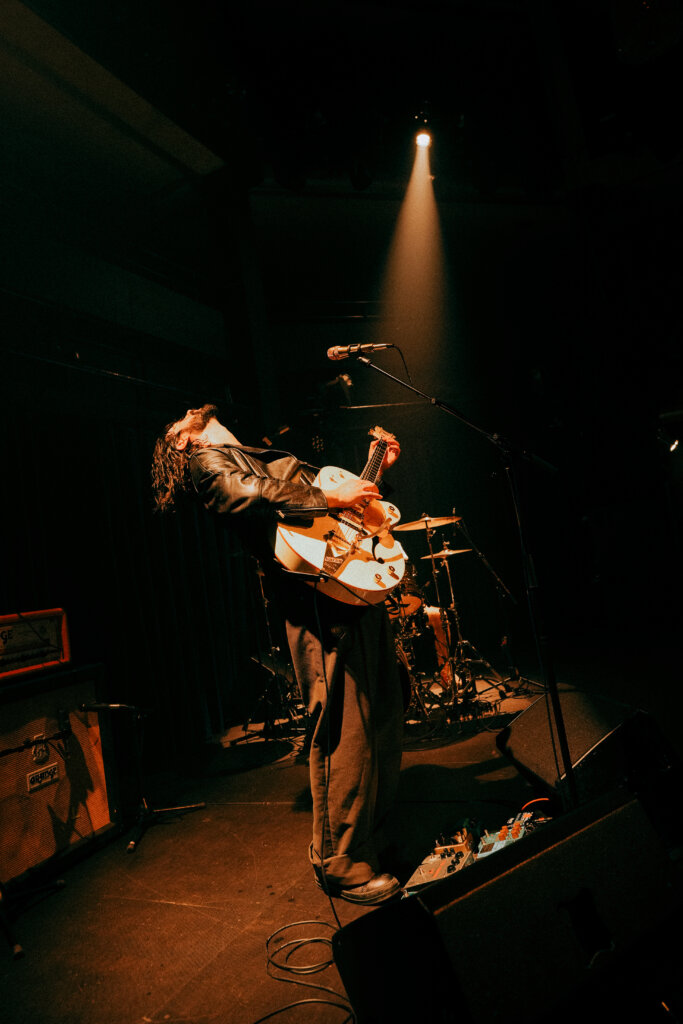
Photo: Cristina Fisher
Rett Smith playing at Treibhaus. Photo: Cristina Fisher
Media, music, money, and a message to our readers
Many of the lyrics on Smith’s new album clearly speak to the current cultural and political moment. The song November 63’ is about the Kennedy assassination, but it feels just as relevant in November 2025. Smith chose the subject because his then eight-year-old mother was just down the street when President John F. Kennedy was shot in Dallas on November 22, 1963. “I remember her casually talking at times about how scarring that was for the nation, and for her as a little girl.” Looking at the state of the country over 60 years later, Smith is worried about political violence increasing and the possibility of another assassination on the President. “I really hope that doesn’t happen because I think that it’s so amplified and so scary that it would be catastrophic.”
When I ask Smith whether he thinks artists should speak out about political issues online, he responds “I think you have the right to say whatever you want to say. And I also think the world has the right to make you have proper repercussions to that, if you’re fucking insane. But I think that Facebook and Instagram should not decide what that is behind the scenes. Because they’re the most corrupt people on the planet.” (A line in Smith’s song Mobile Lord goes “Tell that man on Instagram about my useless fucking vote.”)
It’s the financial interests behind artists’ social media activism, if you can call it that, that alarm Smith. About Taylor Swift’s endorsing Kamala Harris in September 2024, he says “Her stance, I guarantee you, had fucking Deloitte. She probably spent a million dollars on consulting firms before she said anything. That’s no joke. Like, she’s an enterprise.” Authenticity of expression is what’s important to Smith. “I’m never going to knock an artist for doing what they do. Just don’t get paid for it. If you’re getting paid for it, that’s not an opinion anymore.”
Smith is painfully aware of how people with money can make or break your career in music. “The number of girls and boys, and young women and young men, and older women and older men, that have done the work and would have been incredible, who did everything to get there, and then had that stripped away by the pariahs that think they fucking know something. They couldn’t work the lowest level job on the planet, and they’re in in control of tens of thousands of dollars for someone that needs it.”
The situation being what it is, Smith has a message to our readers. “I just want to put it in the university press, because I think that if you’re smart, and you may not have a musical aptitude, but you care about art: go work in music. Because the business needs you. And the ones that are there need to get the fuck out. They’re horrendous. So, go take their jobs, please.”
Performativity versus performing
In his song Soft Boy, Smith takes on the “performative male.” By that, he doesn’t primarily mean the mustached, matcha-drinking, Camus-carrying college student – an association on which he is quick to correct me. “I didn’t want a record that made it sound like I might be some right-wing nutter on this stuff.” It’s the “tough guy shit”, not men being genuinely sensitive, that he’s criticizing. “Performative male, to me, isn’t just the tote bag and the trying-to-get-pussy weirdo, or trying-to-get-guys weirdo. It’s the tech guy pretending to support the arts. It’s the performative cowboy. There’s a huge cosplay-cowboy thing in music that’s really strange to me.” He adds, “‘Neck tat, fuck that’ is the lyric. So, like, you’re all tatted up, and your mom’s paying your rent. You’re acting like a tough guy. Like, be careful that you don’t run into a tough girl. She might do something.”
I have to ask. “How performative is Rett Smith?” Immediately, he responds, “Highly. It takes one to know one.” Right now, he says, he is highly conscious that our conversation is being recorded, that I’ll choose quotes and print them, so of course he’s thinking about how he wants to come across. Ironically, Smith says this is different when he is actively performing. “On stage is when I’m not performative. It’s the biggest performance – it’s the most exaggerated version of myself, though. That’s me to the core. I want to be the truest version myself because then maybe the people in the audience can be theirs. Then we have a room.” He adds, “The best way to make someone dance is to go dance.”
The show – Rett Smitt “to the core”
This proves true. At the concert later, Smith climbs on his drummer’s instrument, roughhouses his equipment, dances like a maniac, and jumps off the stage to play right in the audience’s face. (They love it.)
In a surprising turn, he at one point ditches his electric guitar, sends his drummer backstage, and tells us he will sing a couple of different songs now. He wants to pay tribute to the people who originated blues and rock music – “people that don’t really look like me”, he says – that is, Black people in the South of the USA.
This is my favorite moment of the night. He yells, “You can cut this mic!”, takes a big step away from the microphone and looks straight at the crowd. Almost unrecognizable from earlier, he now stands still, alone on the stage. The crowd listens, silent and captivated, as he sings acoustic in a heartbreaking but strong tone that transports pain and pleading and hope.
And then, this part of the set is over, and he is back to playing rock. For the last song, he takes his shirt off and lets it all out on the stage one last time.
Throughout and after the show, he thanks the audience time and time again for being present in this moment with him. Which we are – I have rarely been at a concert where the connection between the artist and the crowd is this palpable. Smith seems very moved by playing in Innsbruck on this day, two decades after he left Tyrol, and I get the sense that tonight is a second chance.
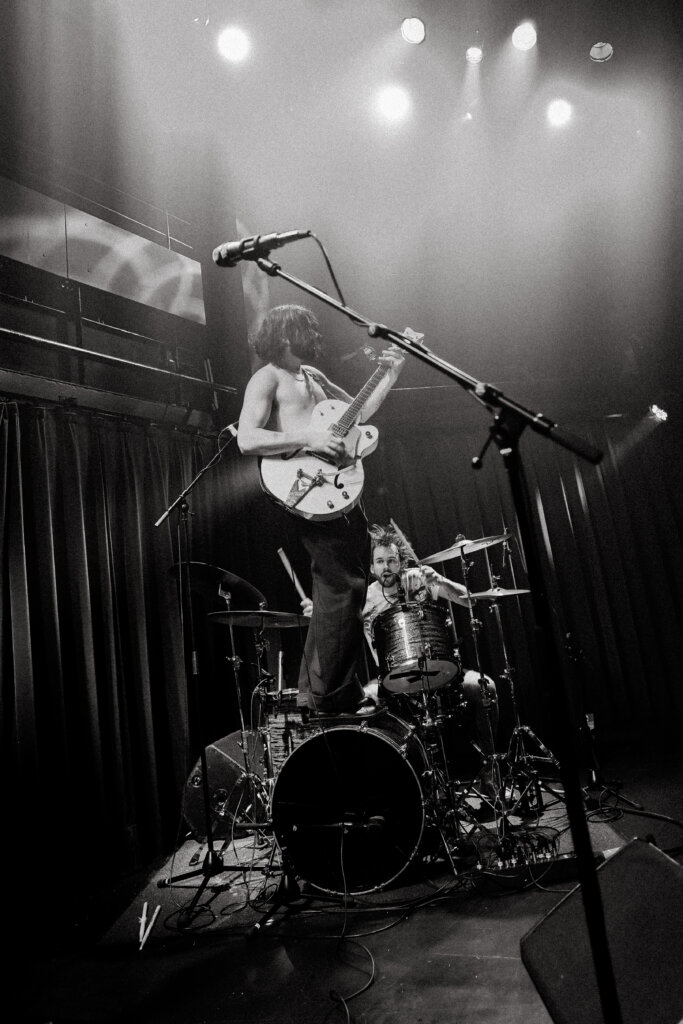
Photo: Cristina Fisher
