
NIIA (pronounced “Nye-uh”) describes herself as a “goth jazz princess.” On the black-and-white cover of her new album, V, out since October 10, she has a heretic’s fork lodged under her jaw – a torture device said to have been used to keep victims of the inquisition in agony. Still, she looks calm, self-assured; her chin held high with pride, not pain. It seems she has not only accepted her fate but taken ownership of it.
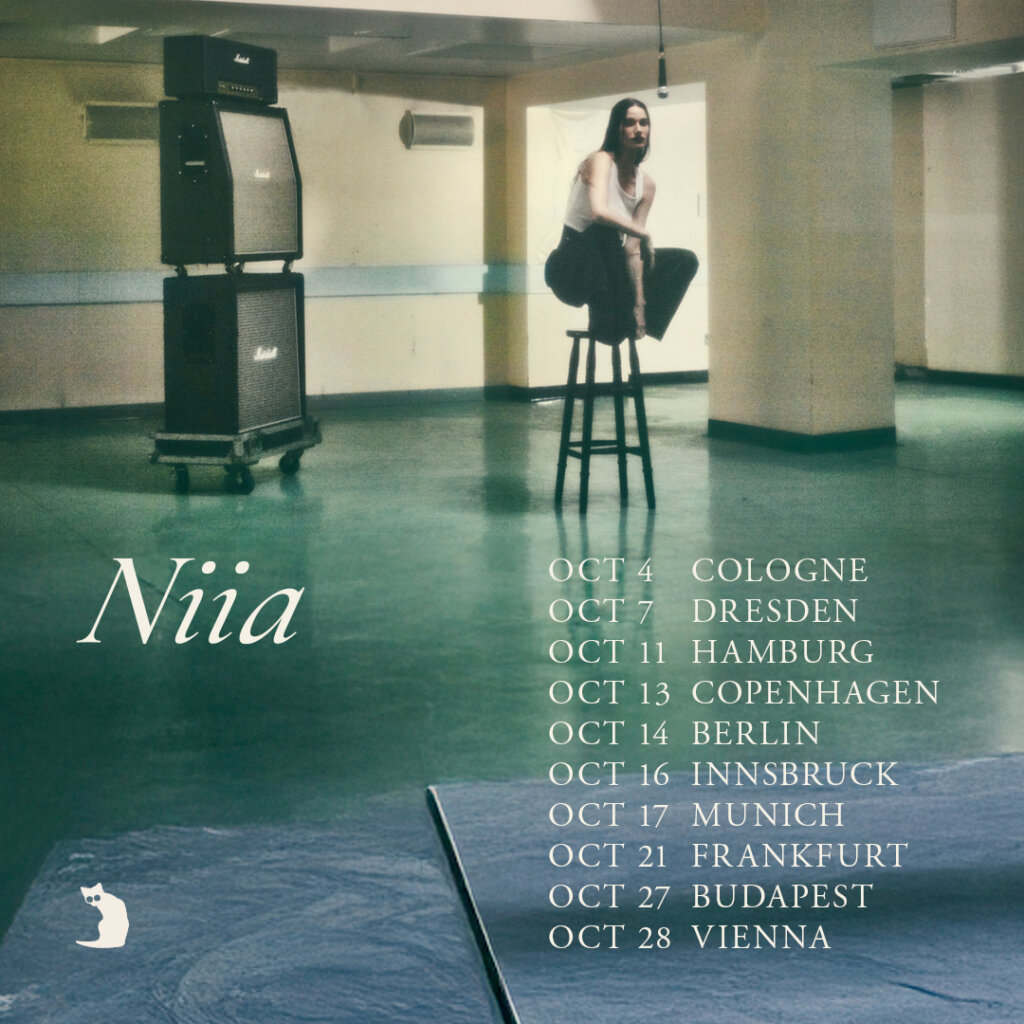
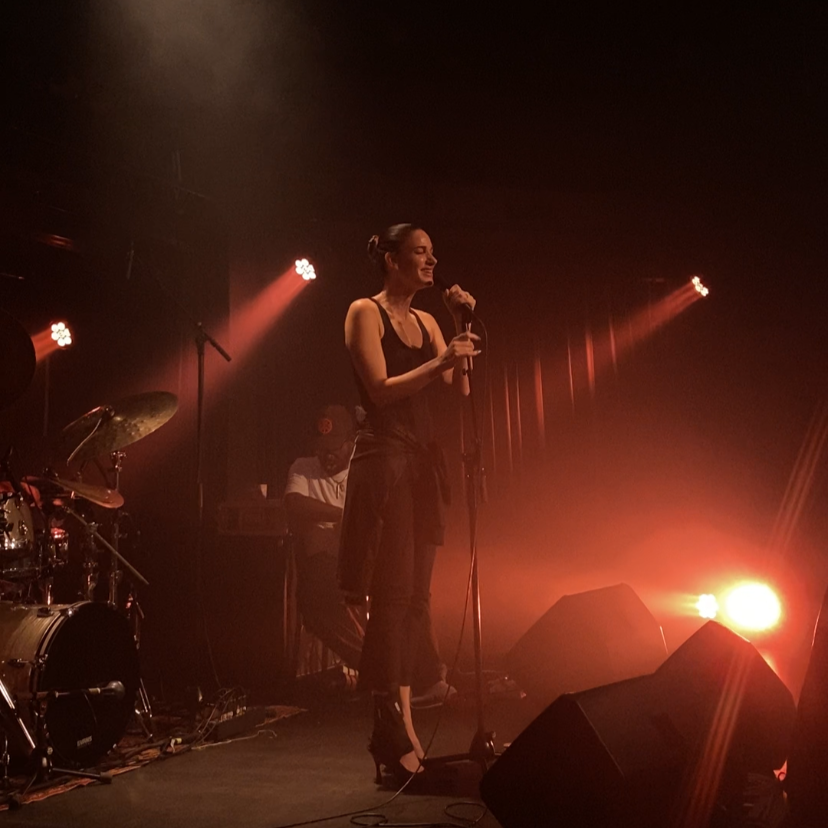
NIIA sings like she knows who she is – for better and for worse. Throughout her album, her voice is pure but sinful, gentle but strong. And it also sounds captivating live, which she proved when she performed at Treibhaus in Innsbruck on October 16. We met her before the show.
UNIpress: NIIA, you’re playing at Treibhaus tonight. How are you feeling?
NIIA: Good. I love Innsbruck. For one, the landscape is crazy. But I’ve noticed that people are out, and there seems to be a younger crowd just enjoying life. This was actually my favorite stop on my last tour.
I remember being like, “Where the hell is Innsbruck? Why am I performing there?” Kind of being a brat. But then I came here… And one, I love the venue. And two, I remember it being so special. People did seem to really care about music. It feels like there is a secret art scene.
This time around, I made my team make sure that we were going to go to Innsbruck. And I feel like this will be a stop I continue to do, no matter how big it is.
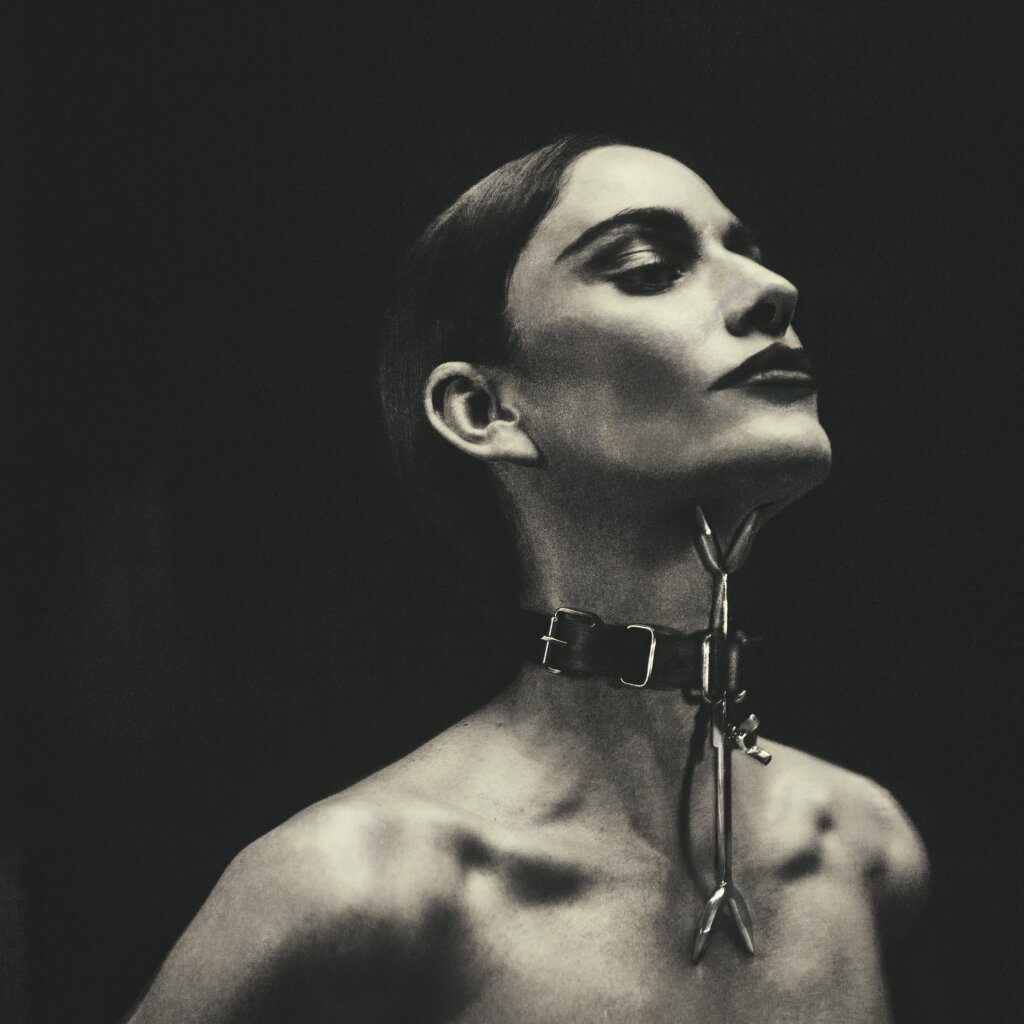 The cover of NIIA’s latest album V, out October 10.
You draw a lot of inspiration from jazz, which is a quintessentially American genre. It originated in Louisiana, among the African-American community, and has been called “America’s classical music.” Now going on a tour to Europe, what has the reception been? Do you feel like your music works here?
I think so. Europe has a lot of really cool jazz scenes.
Jazz has mutated in so many ways. Of course, everyone has to respect the origin story and the history. But we’re not living in the 1920s anymore; we’re living in the 21st century. I feel like jazz has room to grow into other kinds of genres.
I wanted to influence this new record with jazz, but asking the question: what does that mean to me now? I didn’t want to make a throwback record, because if I want to listen to that, I’ll listen to Ella Fitzgerald. I’m not going to try to compete with her. So I wanted to make something new and fresh, but still pay tribute to what came before. And I think it works.
You mentioned the 1920s – the so-called Jazz Age. We’re now in the 2020s, so exactly 100 years later. Do you feel like there’s a chance for there to be a new Roaring 20s?
That’s a great question. I hope so.
It seems like it would have been fun, but also pretty difficult, especially for women and certain artists. When I was studying jazz, it blew my mind that certain musicians weren’t allowed to use the front door. There were so many fucked up things. And they would just let it all out on the stage.
Times are a little dark right now. I do think expressing yourself is necessary, but really scary. We live in an age where everybody has an opinion. The second you say anything, you’re getting judged and criticized. But then you’re being pressured to say something if you don’t. So it’s scary.
I think that the Roaring 20s were just about doing whatever the fuck we wanted. I hope that we can get to a place where people are saying and creating whatever they want, and just going for it. So, I hope there can be a new Roaring 20s – the good parts of it.
Speaking of creating what you want: congratulations on your new album, V. What does it mean to you personally?
I mean, what it means to me personally is that I’m just happy I could make more music. It’s such a gift. I’m so grateful I get to create with people I love and just do this for my job. It’s the most important thing to remember.
I really wanted to try to find a way to let the band and me become a unit. That’s what jazz is all about. It was a really fun process, just putting a bunch of great musicians in a room and seeing what happens.
When you’re recording an album, you’re capturing the sound in a particular moment. But jazz relies heavily on experimentation and variation. Is that easier to do when you’re playing live, like tonight?
You know, that’s a great question. What’s awesome is that the musicians I have with me on tour have such good ears, and they’re all so adept at following each other and listening. Every night is different, to some degree. We have the same set, but the songs take on different shapes. We have to really listen. I’ll change the melody. I can notice when people are picking up different rhythm patterns.
Most artists use in-ears – but then, if I make a mistake, we can’t start over. Or the band can’t follow me, because we can’t really hear everything. Without in-ears, I can just yell over to them, or they follow me if I make a mistake. To me, that’s freeing. Having to play it the exact same way is terrifying.
To me, that’s what jazz is all about. Let’s see what the fuck happens.
Is playing live your favorite part of your work then?
Yes and no. I’m such an introvert, where I love to be alone in a studio with no lights on, just in my safe little cave. It’s taken me years to enjoy performing. I grew up in jazz ensembles. It was more about accuracy, and not about putting on a show.
Now, I’ve understood that there’s a respect between me and the audience. Before, I was just singing for me, and kind of disrespecting everyone. I was so afraid, because there’s so much power from the audience. I’m elevated, amplified, looking down. I never got into music to be a giant star.
But there was a moment where I looked out, and everyone was just looking at me, and I realized, “Oh my God, we’re in this moment together.” That’s when I noticed that performing is really special.
And I can also sing really well live. I thought that was a requirement, and apparently not a lot of artists can, so I’ll do it. (laughs) But yes, I really do enjoy performing, and I’m grateful to anybody who shows up.
We’ve talked a lot about jazz, but you draw inspiration from other genres too, like pop or R&B. Does the concept of adhering to a genre provide you with guidance, with a sense of belonging? Or do you feel restricted?
When you’re studying jazz, you realize that blues came out of jazz, and then R&B came out of blues and soul music. All these genres, to me, are connected in some capacity.
I didn’t like that some of my peers weren’t listening to jazz when I was young. That was when I started experimenting with more pop or R&B. Also, I was young, and I wanted to make music people would listen to – and I didn’t think people would listen to jazz.
But I kind of like being genre-less, to be honest. I’m lucky that people really gravitate to the sound of my voice, which is the staple throughout whatever I’ll do.
And these days, everything is everything. You can’t even really put anyone in a box. Who wants to just be pop? It should be pop, slash, slash, slash. We’re all complex. Sometimes we like different makeup or we change our hair. We can change the channel on our Spotify.
Do you prefer lyrics that draw from your personal life? Or do you also approach writing songs like a fiction author would write a novel?
I wish I was a fiction author. I tell too much in my music. You can know everything about me through my lyrics. My husband doesn’t love it.
Growing up singing jazz standards, there were these really heavy, serious emotions in the songs. My vocal teacher said, “You’re 11, so you don’t understand what it’s like to be cheated on. But you have to really understand these emotions.” As I got older, feeling them was the easiest way for me to write about them. And now, I can’t really write about something I haven’t experienced.
I only work with female lyricists. It wasn’t intentional; it just happened. They know me really well, and they can help rein it in sometimes when it gets too crazy. But it always has to be autobiographical.
I feel like these days, there are so many great female artists really going there with their lyrics. There’s a lot more courage to show women not always being perfect. I love that everyone’s really empowering and pro-women, but there’s also another side. It’s hard. And we can talk about our mistakes, too. I really like to sing about all the things I do wrong.
Is it your ambition to make music that appeals to women specifically? To be a female voice?
I mean, it’s never intentional. I think it maybe happens because of some of the pronouns I’ll use, like “he”.
I feel lucky that when I see my audience, there are all kinds of people. But I do really worry for young girls. I think the younger generations are really struggling. I’ve read some statistics recently that really upset me. I went to an all-girls school growing up and that was brutal, but it also showed me that women are supposed to take care of each other. They didn’t take care of me in high school, but still.
I don’t try to write just for women. I think it just happens because I happen to be one. But I love some of my gay fans because they’re just like, “This song is for me.” I’m like, great. You can hate my husband too. (laughs)
It’d be weird if I only had one type of fan. No disrespect to people that only want to talk to a certain group of people – I get that, especially in certain genres. But jazz is tricky too, because it’s a genre where being a skinny white girl can be judged a lot. It’s really important to be authentic, make it your own, and understand the history.
What do you think it’ll be like to get back to your everyday life after this tour?
Man, if I only knew. I think it’ll be just walking over my suitcase for about two weeks instead of doing the laundry. I’ll just probably sleep and try to get back into eating healthy and working out. Seeing some friends, calling my mom, and then figuring out what I want to do next. But taking some time, because I need to absorb everything first.
Of course. The album has been out for less than a week, so you’re still in it all.
I know. I’m scared to hear what some people have to think about it, but particularly my husband.
Has he not heard it?
He hasn’t heard a few songs.
Interesting. Was that intentional on your part?
Kind of. I don’t think he’ll love them, but we’ll see. Just some relationship stuff that I’ll have to sort out when I get back.
And then I’ll take it easy. I can be a little too hard on myself and move fast. But I think I’ll give myself some grace. And maybe volunteer.
I think sometimes being an artist – I don’t mean this negatively, but it’s very narcissistic. And it has to be, because my work has to be true to me. But it’s important to sometimes step away from yourself, do something for other people, and realize that it’s not all about you.
I like to ask this at the end: Is there anything that you’ve always wanted to talk about in an interview, but no one has ever asked you?
Maybe if the rumors are true that I’m a witch. (smiles)
Are you?
I think so. I just have that sixth sense. And even my album cover, that collar I’m wearing is a torture device that was used to silence “witches” and women.
I need everything to make sense. So all the visuals surrounding my album have Easter eggs like that.
Yes, I noticed the white cat on your album/tour art. I haven’t figured out what it means yet.
I have to make the trail, but it’ll happen. Her meaning’s coming.
Nine lives, baby.