

This interview was conducted in English. If you would prefer to read a translated German version , you can find it here. / Dieses Interview wurde auf Englisch geführt. Wenn Sie lieber die ins Deutsche übersetzte Version lesen würden, finden Sie diese hier.
It is an eventful time in United States politics. Just last week, former president Donald Trump was indicted on 37 felony counts revolving around alleged unlawful keeping of classified documents, some of which he supposedly stored in a shower at Mar-a-Lago, a Trump-owned resort in Florida.
As the 2024 presidential race draws nearer, potential candidates are launching their campaigns. President Biden has announced that he is seeking re-election for the Democratic party. On the other side of the political spectrum, several candidates are competing for the Republican nomination, among them former president Donald Trump, former vice president Mike Pence and Florida governor Ron DeSantis.
In this interview, Dr. Phillip Ardoin, professor of American politics at Appalachian State University in North Carolina and visiting professor at the University of Innsbruck, discusses his hopes, fears and predictions for the 2024 election. He also explains why the American presidential election is not actually democratic and why the parties have a score on every single voter, and he sheds light on political polarization in America and the role of social media.
Dear Dr. Ardoin, what do you think is currently the biggest problem facing American democracy?
Dr. Phillip Ardoin: To be blunt, I would say Donald Trump and the growth of political extremism. And the loyalty to him among his partisans.
Recently, he was indicted and he’s completely denying having done anything. And so many of the elected officials are so afraid of him they’re not saying anything, or they have jumped on the bandwagon, accusing the Department of Justice of running a political campaign against him. The evidence clearly shows he’s guilty, but his followers and the party in general are more worried about being loyal to him than being loyal to the institutions and democracy.
And this is how modern democracies end. It’s not through revolutionary war; it’s this slow support of authoritarianism and individuals putting a party or an individual above the rule of law and government institutions. I see that happening in America. Growing up in America during the Cold War, we would read about these things happening in the Soviet Union. You didn’t think that would ever happen in America.
Do you think Trump is a symptom or a cause?
PA: I think he’s a symptom.
Of what?
PA: The growing polarization and divide in America. But he has propelled it as well. There are also examples in the Democratic party, like AOC and Bernie Sanders, who increase polarization and attack the other side as evil, and they get a lot of political power from that. But those people haven’t risen to the level of power or to the highest office like Donald Trump has.
And he has not only used that to propagate himself and get office and raise money, but he has inspired a whole new younger type of Trumpian candidate. We see this with Marjorie Taylor Greene and other candidates who simply don’t care about the truth, who just want to attack the other side and who will say anything for political gain.
I didn’t think that would ever happen in America.
You mention these individuals that drive polarization. What do you think are some structural or systemic causes?
PA: One of the primary factors driving polarization in America and throughout the world – because we’re seeing political polarization increasing all over the world, both in developing and industrialized countries – is social media. One, social media allows us to live in these filter bubbles, where we only hear the information we want to hear, whether purposefully or unknowingly. Web filters don’t provide us with information we don’t like because that would stop us from coming back.
The other way social media is driving polarization is the ability of the elites to contact the public directly and spread lies. Donald Trump held a rally after being arrested and indicted, and he gave this preposterous 30-minute speech that was just filled with lies. Twenty years ago, news outlets would have covered that speech, but they would have put it in context and would have provided another perspective or edited out the lies. But that speech now goes directly to anyone who lives in a conservative news bubble. They’re not hearing the justification and the legal precedent of the indictment and the recordings of Trump contradicting himself.
How do you see the indictment proceeding?
PA: One thing that has already happened is that he has raised millions of dollars. He is using this as a campaign tool. After his last indictment in New York, he raised millions in 24 hours. He held two separate fundraisers last night, one in Miami and one in New Jersey. To some extent, the initial indictment helps him.
Where it goes, I don’t know. How much he’s able to delay it. If we can get this trial and get him to be found guilty by January, before the Republican primaries start, he would probably not get the nomination as the Republican candidate. That would be my hope. But if this drags out and he becomes the official candidate for the Republican party, with a Democratic Department of Justice indicting him, this would get really nasty.
And this could be the breaking point. If he is the candidate, how does the American electorate respond to that campaign? If he’s found guilty or he loses the election, does he start another insurrection like on January 6th? You just don’t know. This is so unprecedented.
Even if Trump is in jail, he can still run for president. How would that work?
PA: I don’t know; it’s never happened. But when you look at the things that make you ineligible to run for office, being a felon is not one of them, even though you can’t vote as a felon. And once you’re president, they can’t put you in prison. They can’t do anything; they can’t try you; there’s immunity as president. He would buy himself four years.
If Trump gets the nomination, this would get really nasty.
When Trump won the presidency in 2016, he actually lost the popular vote. But he won because the electoral college gives more weight to voters in smaller states. Is this not undemocratic?
PA: Well, America has a republican system of government – small-R republican, not as in the Republican party. We have a federal system. So our president is not democratically elected.
You make a distinction between republicanism and democracy?
PA: Yes, and federalism. We have this recognition of the importance of states in America. And the electoral college to some extent reflects that. Not that I agree, and I do think the electoral college should be eliminated. It made sense 100 years ago, when we were much more state oriented. But I think now, with the nationalization of American politics, we should have a direct election.
But imagine if the European Union was electing a single leader, would Austria want that to be just a popular vote? Or would you want each country, even smaller countries, to have a role in that?
Smaller states have unique interests, and that’s the core and the initial thoughts behind the electoral college. But state boundaries in America matter much less today than they did even 30 years ago.
And one of the really interesting things with the electoral college is how it’s resulted in the presidential campaigns only really focusing on a very small number of states. In the 2024 presidential election, visits and campaign dollars will be focused on probably six to eight states. The other 42 states throughout the country will be completely ignored. There are no presidential campaign ads in non-competitive states like Louisiana, where the Republican party knows they’re going to win that state, even a week before the election. In North Carolina, on the other hand, you can’t turn on the TV without seeing presidential campaign advertisements starting eight weeks before the election. Presidential candidates will visit a single town with 20,000 people in North Carolina, a battleground state, four times, but will never visit the entire state of California once.

Photo: Elias Walder
Who do you have your money on for 2024?
PA: If you put a gun to my head right now – and in America you would have that gun (laughs) – I would bet on Joe Biden winning the election if Trump gets the Republican nomination. But I wouldn’t be willing to bet more than five euros. I’m no more confident than that.
If Donald Trump is not the Republican nominee, I would guess that whoever the Republican nominee is will win the election. Joe Biden is too old to be running for president, and I don’t understand why the Democratic party – and Joe Biden, to be honest with you – is moving in that direction. He’s 80 years old now. I’m not questioning his mental stability right now, but four years from now… And just his endurance. I’m 53, and I can’t imagine 27 years from now even being department chair at the university, much less the president of the United States of America.
When you look at pictures of presidents when they assume office and when they leave office, the difference is huge. They look like they’ve aged two decades. It’s such a demanding job.
Both parties have a score on me. They basically know what I think.
If not Trump, who? DeSantis?
PA: It’s too early to tell. When you look at July of 2015, no one would have predicted Trump being the candidate in 2016. In 2007, most people didn’t even know who Obama was.
We’re seven months out from the start of the primary season, and so much can happen in those seven months. Is the indictment going to solidify Trump as the nominee or will it destroy his hopes? Does that then lead us to a candidate who has criticized Trump or supported him?
If you could change anything about the political system in America, other than the electoral college, what would it be? What are the biggest avenues for reform?
PA: Redistricting. This is getting into the weeds a bit, but it’s actually the elected members of the state legislatures who draw the congressional and legislative districts. So elected officials get to decide: Who are the voters that I am going to face in the next election? Since they have that ability, and with technology and data on the American population, they are able to go in and draw electoral districts that guarantee their electoral success. They literally go house by house.
And this has always been the case in America, but we’ve never had this amount of information on the individual households and voters that we can do it so effectively. With microtargeting, we now know for literally every street if there are 12 Democrats or eight Democrats, and do I want that street as an elected official or do I only want half of that street to be in that district.
I am registered as an independent in North Carolina, but both parties have a score on me that tells them my propensity to vote for them. They know my social media feeds, where I spend my money, who I hang out with. They basically know what I think.
And when you know as a Republican that the district is yours, you don’t have to worry about Democrats. You have to worry about candidates that are even further right than you getting the nomination instead of you. There is a disincentive to be moderate.
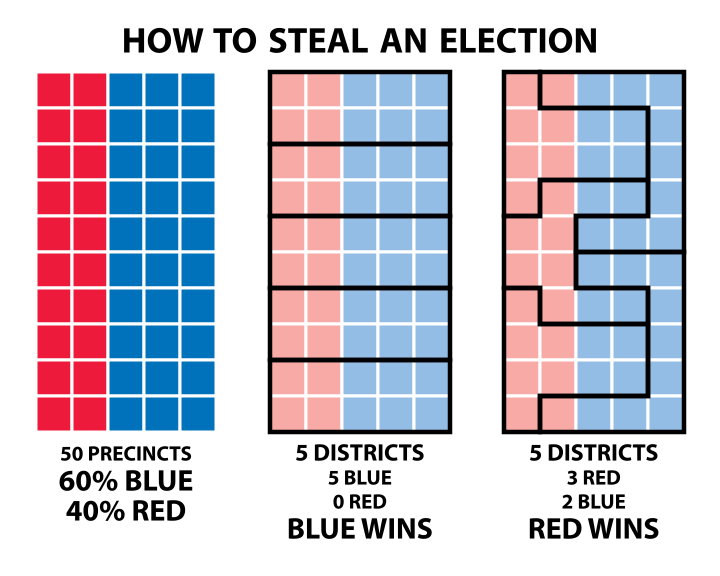
An example of redistricting. Credit: Steve Nass, CC BY-SA 4.0 <https://creativecommons.org/licenses/by-sa/4.0>, via Wikimedia Commons
In the United States, you have to register with the authorities in order to be able to vote. Do you think that system also needs reform?
PA: No, I mean, that’s an issue. But it’s funny, with all of the work of legislators trying to suppress the votes, it’s garnered so much media attention and donations to voting campaigns that we have seen turnout actually increase.
For example, my university has the largest number of Democrats in our county, so the Republican party has done a lot to try to prevent students from voting on campus. But those activities have just made students mad, and it’s brought so much attention to the election that over the last eight years we continuously see voter turnout among students higher than it’s ever been. The best way to get a student to do anything is to tell them the authorities say you can’t do it. The students are going to vote just to piss them off.

1 Kommentar
Concise, professional, and informative with a dash of humor. Just how I like my journalism. Thank you.