There have been as many plagues as wars in history; yet always plagues and wars take people equally by surprise.
–Albert Camus, The Plague («La Peste»), 1947.
Camus’s writings and philosophy have been invoked countless times in the past year to make sense of the ongoing pandemic, with The Plague once again becoming a bestseller and numerous takes being published about how it “became the defining book” of the current conjuncture. For instance, Alain de Botton wrote that Camus was captured by pestilence fiction due to his view that epochal events such as plagues or wars are “dramatic instances of a perpetual rule: that all human beings are vulnerable to being randomly exterminated at any time” — and this can be done by a deadly pathogen just like through the lethal consequences of deliberate human actions.
Indeed, Camus observed that disease outbreaks or armed conflicts have similar effects on humanity in a sense that they expose our incapacity — or rather indisposition — to adequately overcome them. They are a recurring feature of human history, yet we seem to never really be prepared when faced with their resurgence. They lurk beneath the thin ice of society’s fragile peace and health systems, ready to emerge at any time and pounce on the most vulnerable. They come and go and return like waves. They are “deadly comrades” that “have accounted for a major proportion of human suffering and death.”
“Heroic” Couch Potatoes and Wartime Leaders
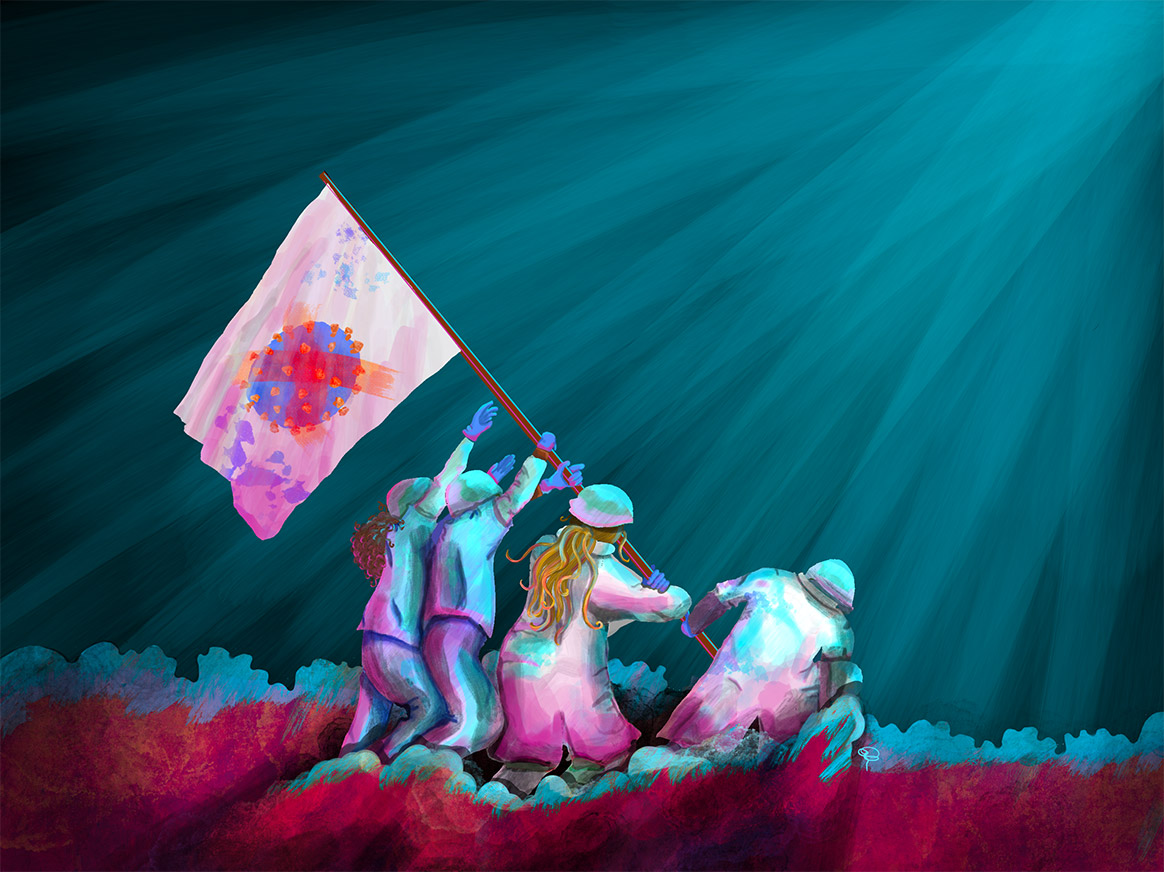
It is no wonder then that comparisons of wars and plagues persist. After all, analogies can contribute to our understanding of the present, and the present does feel like living during wartime. Consider Angela Merkel’s unprecedented televised address in March calling the pandemic the biggest crisis for Germany since World War II. Then, as the second wave came crashing in, the German government released a campaign video calling for everyone to stay at home on their couch — the frontline for these “special heroes.”
The German Govt's latest Corona advert – now subtitled in English. Quite good. pic.twitter.com/nbRZIm9RcN
— Axel Antoni (@antoni_UK) November 14, 2020
Moreover, according to war studies professor Lawrence Freedman, the current moment does resemble an era of conflict, considering that it “requires the same resilience and appreciation of danger, as governments are obliged to promise that they will do ‘whatever it takes’ to keep their people safe.” Lacking a definitive objective, the success of how governments respond is measured by national death tolls, which are often wrongly estimated and thus unreliable. In order to cope with rising numbers of infection and death, states demand the assistance of their citizens. Everyone is called to fulfill their duty to contain the pandemic; every citizen is told to do their bit and to perform a “special” kind of “heroic” action.
Consider how UK premier Boris Johnson, days before being infected himself, addressed the British public last March: “[I]n this fight we can be in no doubt that each and every one of us is directly enlisted.” By subsequently stressing that “[e]ach and every one of us is now obliged to join together,” Johnson evoked warlike sentiments which illustrate the imperative for society to make a huge sacrifice to achieve a certain goal — coming together to “beat” a common “deadly enemy.”
We have the resolve and the resources to win the fight against #Coronavirus pic.twitter.com/g1SnxlMEzV
— Boris Johnson (@BorisJohnson) March 18, 2020
Indeed, pundits and commentators sympathetic to the British prime minister dubbed his leadership amidst the crisis as his “Churchill moment.” While across the Atlantic, the US — which has constantly been breaking daily infection and death records — saw Donald Trump designate himself as a “wartime president” fighting an “invisible enemy,” ignorant of the fact that, as Catherine Connolly correctly points out, he is already a wartime executive as commander-in-chief of the US military “continuing its ‘war on terror’ in numerous countries.”
Flawed Comparisons and Expectations
There are indeed some undeniable characteristic parallels between wars and pandemics, but recklessly invoking such analogies can be faulty for various reasons. The most crucial one, according to Freedman, is that “it is offensive to suggest that those inflicted by the disease have been called to combat, as if their survival depends on inherent willpower rather than medical, social and economic factors far beyond their control.”
Underlining this call for mobilization is the heroization of healthcare professionals and other essential workers, who are exposed to greater risks than the average person and have thus been labeled as “frontliners” or “war heroes.” As with soldiers in war, this creates an expectation for them to internalize that they have to face a risk for the greater good, leading to the notion that they are less “essential” and more “sacrificial”.
Another problem with succumbing to war metaphors is that it evokes an expectation of peace. War is conventionally defined as an armed conflict between groups and entities and as such it is expected that it has to end at some point, such as through peace deals. But you cannot forge a deal with a virus, which makes the use of warfare rhetoric questionable. Nonetheless, governments worldwide have often utilized such language to wage “wars” against a variety of issues that “plague” society — from Johnson’s “war” on poverty to Bush’s “war” on terror to Duterte’s “war” on drugs.
Considering the war metaphor’s conspicuous unsuitability of describing the pandemic, it does seem strange that so many political leaders broadly employ such perplexing narratives. So what is it that drives governments all around the globe to resort to the language of war despite its inaccuracy?
Finding Meaning and Mobilizing Valor
Essentially, what these metaphors do is that they produce meaning by applying existing vocabulary to virus-related contexts in order to better describe the situation and help us cope. Sociolinguistics professor Robert Lawson put it in the following way: “In times of significant social or civic change, linguistic creativity not only reflects the major preoccupations of the time, but also shows how people gather to talk about new challenges and contexts.” This linguistic coping mechanism is not exclusive to the novel coronavirus, considering that metaphors have a long tradition of being used to describe diseases and have been analyzed extensively. Susan Sontag, for instance, investigated the use of metaphors in the discourse surrounding HIV/AIDS.
Indeed, the war analogy has proven to be predominant in the discourse surrounding Covid-19 because it gives the possibility to emphasize the seriousness of the virus — to underscore the importance of realizing the severity of the situation that merits swift action. Leaders thus resort to such metaphors in order to convince the people to comply and cooperate.
Moreover, these metaphors are appealing because of their capacity to mobilize or orchestrate acts of heroism. In addition to highlighting the “heroic” acts of healthcare workers, such language also gave political officials the opportunity to prove themselves as “strong” leaders, leading to a boost in their popularity and the consolidation of the power of the state. Since “war is the business of the state par excellence,” as Alexandre Christoyannopoulos writes, there is no wonder then that the framework of state responses to the pandemic is wrapped “in military language [that] reinforce[s] such statist thinking.”
However, such securitized narratives are prone to exploitation by political actors who take advantage of the crisis to call on distorted memories or reclaim a mythical past to further justify the extensive use of military force, which reinforce nationalist sentiments and reactionary imagery that generate fear, diffuse public panic, inflame xenophobic paranoia, and deepen further social polarization in a period where cross-border unity is desperately needed.
From a Rhetoric of Aggression to Narratives of Solidarity
We should be skeptical of instrumentalizing narratives of war as the intuitive answer to critical situations such as the current Covid-19 pandemic. Using a language that glorifies “strong” leaders and uses national infection rates and death tolls as a metric for success falls short of meeting a challenge that is global in nature. The ultimate goal is not to broker a “peace deal” between national leaders and invading pathogens — as the war rhetoric might suggest—but rather, it is to ensure global health security by emphasizing transnational cooperation.
While there is indeed a need to communicate the severity of what we are all facing, it should be acknowledged that the virus cannot be contained within the confines of nation-state borders. This entails a robust response that emphasizes health as a fundamental human right rather than a mere national prerogative.
Camus, in accepting the Nobel Prize in Literature in 1957, said that every generation undoubtedly “feels called upon to reform the world,” which includes the colossal task of “preventing the world from destroying itself.” This sentiment bears utmost scrutiny in today’s turbulent era where the imperative to prevail over a universal threat necessitates drifting away from militaristic rhetoric. Instead, we must foster a more sensible approach and turn towards transformative narratives that put people at the center and affirm humanity’s mutual interdependence.